
The Future of TESLA

The future of Tesla as a public company will this week be discussed at the company board meeting. This comes after the Tesla CEO, Elon Musk tweeted (7th August 2018) that he is planning to take the company private.
This move has raised eyebrows in the investor community who questioned the rationale for taking this bold action. Musk explained his rationale for this move in an email to Tesla employees:
Earlier today, I announced that I’m considering taking Tesla private at a price of $420/share. I wanted to let you know my rationale for this, and why I think this is the best path forward.
First, a final decision has not yet been made, but the reason for doing this is all about creating the environment for Tesla to operate best. As a public company, we are subject to wild swings in our stock price that can be a major distraction for everyone working at Tesla, all of whom are shareholders. Being public also subjects us to the quarterly earnings cycle that puts enormous pressure on Tesla to make decisions that may be right for a given quarter, but not necessarily right for the long-term. Finally, as the most shorted stock in the history of the stock market, being public means that there are large numbers of people who have the incentive to attack the company.
I fundamentally believe that we are at our best when everyone is focused on executing, when we can remain focused on our long-term mission, and when there are not perverse incentives for people to try to harm what we’re all trying to achieve.
This is especially true for a company like Tesla that has a long-term, forward-looking mission. SpaceX is a perfect example: it is far more operationally efficient, and that is largely due to the fact that it is privately held. This is not to say that it will make sense for Tesla to be private over the long-term. In the future, once Tesla enters a phase of slower, more predictable growth, it will likely make sense to return to the public markets.
Here’s what I envision being private would mean for all shareholders, including all of our employees.
First, I would like to structure this so that all shareholders have a choice. Either they can stay investors in a private Tesla or they can be bought out at $420 per share, which is a 20% premium over the stock price following our Q2 earnings call (which had already increased by 16%). My hope is for all shareholders to remain, but if they prefer to be bought out, then this would enable that to happen at a nice premium.
Second, my intention is for all Tesla employees to remain shareholders of the company, just as is the case at SpaceX. If we were to go private, employees would still be able to periodically sell their shares and exercise their options. This would enable you to still share in the growing value of the company that you have all worked so hard to build over time.
Third, the intention is not to merge SpaceX and Tesla. They would continue to have separate ownership and governance structures. However, the structure envisioned for Tesla is similar in many ways to the SpaceX structure: external shareholders and employee shareholders have an opportunity to sell or buy approximately every six months.
Finally, this has nothing to do with accumulating control for myself. I own about 20% of the company now, and I don’t envision that being substantially different after any deal is completed.
Basically, I’m trying to accomplish an outcome where Tesla can operate at its best, free from as much distraction and short-term thinking as possible, and where there is as little change for all of our investors, including all of our employees, as possible.
This proposal to go private would ultimately be finalized through a vote of our shareholders. If the process ends the way I expect it will, a private Tesla would ultimately be an enormous opportunity for all of us. Either way, the future is very bright and we’ll keep fighting to achieve our mission.
Thanks,
Elon
If Musk succeeds to convince the Tesla board to go private this action will be a major shift from the tradition. The markets have always been a preferred avenue to scaling tech companies. The move by Musk indicates that there are alternatives that can be considered.
A number of Silicon Valley companies have also shown signs of avoiding public markets. Here's the list of Silicon Valley that avoided public markets:
- Spotify
- Uber
- AirBnB
Spotify: decided to skip a bank-brokered initial public offer (IPO) in favor of selling several million shares directly on the New York Stock Exchange.
Uber: did its own mini-IPO, raising $9 billion from a SoftBank-led consortium in 2017.
Airbnb: now valued at $31 billion, recently ditched its CFO, who was eager for an IPO, and insisted that the company would go public on its own time. Media reports show that since 2000, the average number of new companies deciding to IPO each year has fallen from 300 to about 100.
JACK MA Lessons for Digital Africans
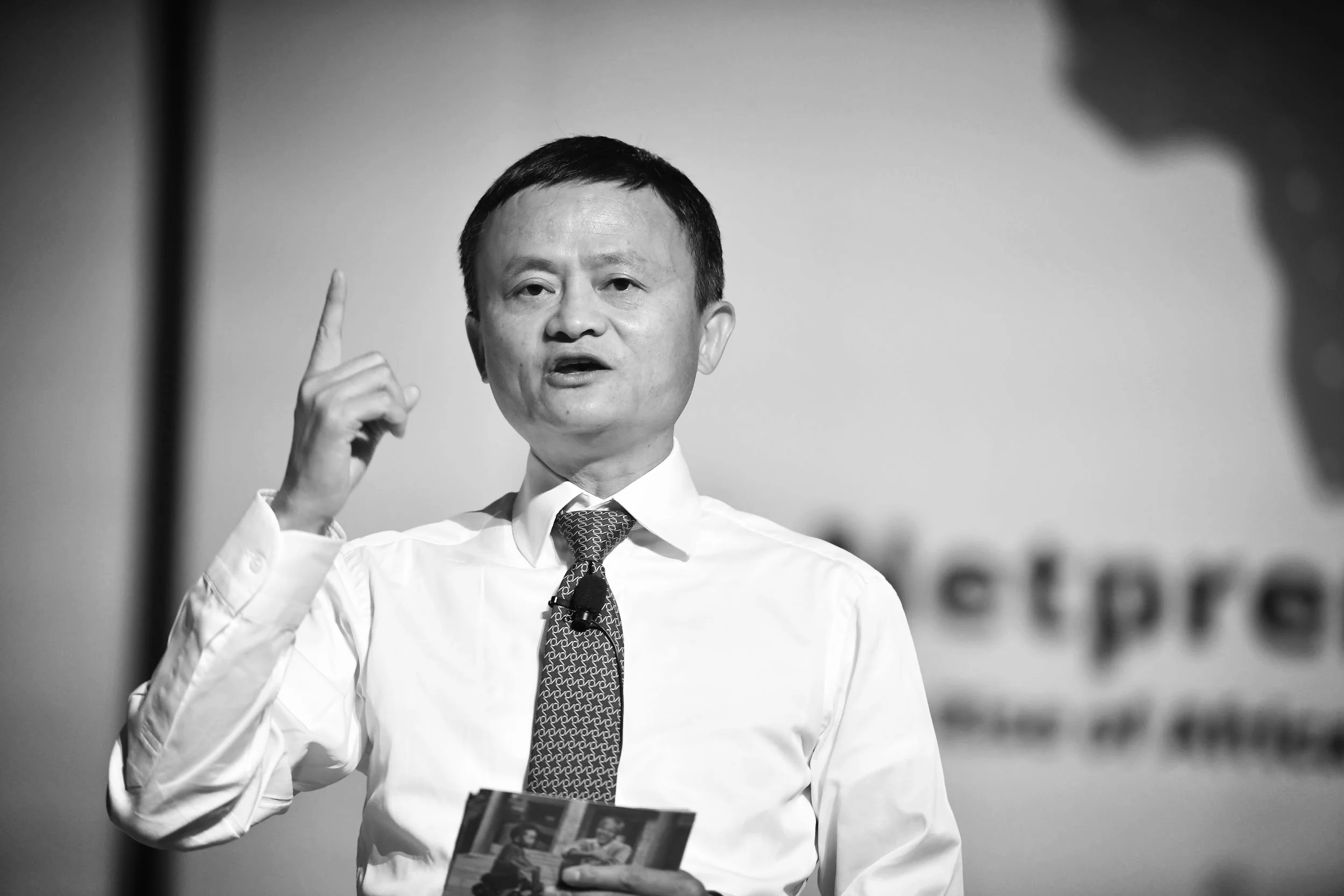
Jack Ma speaks at Netrepreneurs event in South Africa
This week will go down in history as the significant moment for people who are working towards building the Digital Africa. Jack Ma, the billionaire founder of the Chinese Unicorn, Alibaba, visited South Africa for the first time and delivered probably the most important entrepreneurship talk in the African continent. The man who built one of the most important e-commerce platform in recent history shared his story with young technology entrepreneurs, legislators and academics. In his talk he had a message for entrepreneurs and government leaders.
He began by outlining what it took to build Alibaba in the 90’s in China. At the time China had no internet (it was installed only after 3 months after he registered the business) and people knew nothing about selling online. Jack Ma understood the importance of building an internet company in the country after he realised that Chinese products were not available in the global internet at the time. The fact that China had no internet during the time at which Alibaba was established meant that Ma had to teach even journalists about his services. According to him this was a challenge but also an opportunity. People did not know what he was talking about when he spoke about the internet as a result it was also difficult to get people (engineers) to work for Alibaba. At the time the competitor for Alibaba was eBay (an e-commerce company) and they were attracting the brightest minds from leading academic institutions. Banks were also not making life easier as they were refusing to lend him money to build his business.
According to Ma, due to lack of understanding of the internet, his company received less support. As a result this experience taught him to expect no support in the process of building a business.
LESSON FOR ENTREPRENEURS
The story of how Alibaba was founded is an important one for South African entrepreneurs as digital conditions in Africa are similar to what China was during the early days of Alibaba. In Africa a number of countries have poor internet connectivity, the general population lacks the understanding of the digital world. According to the founder of Alibaba these African conditions should inspire African tech entrepreneurs to develop solutions. The very fact that Africa lacks infrastructure should be considered by local tech entrepreneurs as an opportunity to build such infrastructure aswell as services on top of such infrastructure.
In Europe, almost everything that needs to be built is already in place and therefore opportunities are limited, this is not the case about the African continent. The lack of infrastructure in China were instrumental in making Alibaba what it is today. Alibaba is now one of the leading 10 digital platforms in the world.
It was built under conditions of very limited support from government and other institutions. The same is true about building a business in South Africa. Although it is claimed that there’s support, the reality is that there’s very limited support for entrepreneurs. The lack of support however should not discourage entrepreneurs from pursuing their dreams. According to Jack Ma entrepreneurs must get used to not getting support even from family members. Jack indicated that the first 10 years of Alibaba were not easy. Failure was part and parcel of his entrepreneurial journey. In South Africa, failure is viewed negatively. Jack Ma encouraged entrepreneurs to learn from failure and mistakes in order to learn how to face them in the future.
LESSON FOR LEGISLATORS
The talk was also addressed to South African legislators who are leaders in government and some who formulate policy. He had an important message to share with legislators which if taken to heart can influence the success of SA Startups. He called on legislators to create an enabling environment for young companies and startups. He suggested that less tax for these companies can serve as an important instrument to drive their progress and success.
He called for leaders to start viewing entrepreneurs as heroes of our time. He concluded his talk by committing to support African tech entrepreneurs. He announced and established a new contest that will see African entrepreneurs compete for $10 million in funding, with the aim of supporting businesses that are growing the continent’s digital economy. The Jack Ma Foundation Netpreneur Prize, will enable small businesses in Africa to vie for $1 million in prize money every year for the next decade, starting in 2019.
Jack Ma Foundation will host an annual pitch competition, with all 10 finalists receiving grant funding and access to the Netpreneur community of African business leaders for mentorship and other resources.
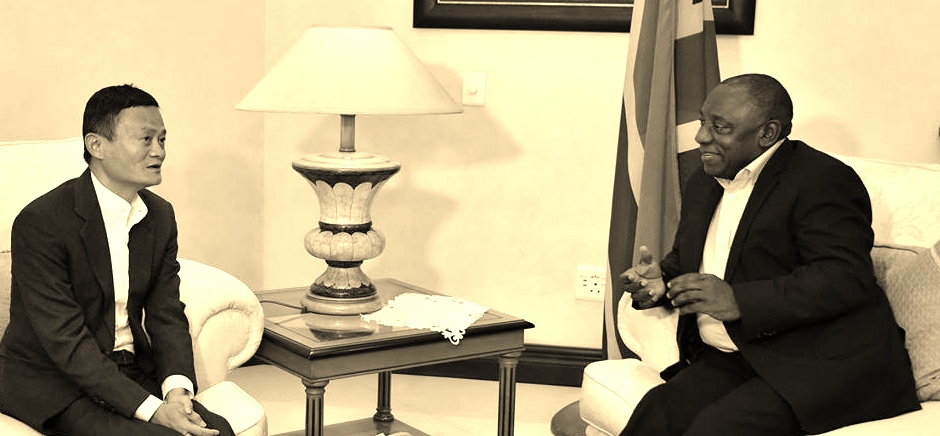
Jack Ma meets SA President
The first visit by Jack Ma in South Africa is significant for a number of reasons. Besides the important support provided to local tech entrepreneurs the visit also received the attention of government. Jack Ma met briefly with President Ramaphosa. It is hoped that Jack Ma’s talk and visit will bring to the fore digital matters to the South African government. To build the future of the African economy there will be a greater need to build the digital economy. South Africa needs more similar initiatives to build the digital economy by developing digital businesses.
South African tech entrepreneurs should aim to create leading digital businesses not just in the country but across the continent and beyond. In the next 10 years when the Jack Ma Foundation Netrepreneurs Prize comes to an end, African digital entrepreneurs should have created at least 10 unicorns that will lead the African digital future.
JACK MA Live in South Africa
Jack Ma, The founder of the Chinese “unicorn”, Alibaba Group, will be speaking in South African in the few minutes to South African start-ups and entrepreneurs.
OPEN LETTER FROM SOUTH AFRICA TO JACK MA

Jack Ma, Alibaba Founder.
DEAR MR. MA,
The South African technology startup community is extremely excited about your first visit to South Africa. The excitement is inspired partly by the fact that the South African tech startup eco-system considers your success as an inspiration. Your success with Alibaba is the proof that it is possible to create something of value outside of the United States of America. Your humble beginnings in the technology sector resonates with many tech startup founders in South Africa. There’s a belief amongst many that your visit will mean something for many tech startups that are struggling in the African continent.
A few days ago, President Xi Jinping was in South Africa for the first BRICS Summit in the continent. Some of us questioned the fact that technology leaders ,like yourself, were not part of this important meeting for the BRICS Nations. Some of us also recommended that the next BRICS Summit should include technology leaders like yourself.
The fact that in a matter of days after the BRICS Summit 2018 you are visiting South Africa is considered a blessing for many who were hoping for your leadership and presence at the BRICS Summit 2018.
One of the conclusions by leaders from Brazil, Russia, India, China and South Africa was that there should be more trade between BRICS countries beyond the BRICS Summit 2018. Some of us felt that the trade between BRICS nations can be enabled by technology . Some of us felt that yourself and other leaders from all BRICS countries should start a process of developing digital means of enabling trade amongst BRICS nations.
Now that you are visiting South Africa, hot on the heels of BRICS leaders, consider a creation of a BRICS Digital platform together with other technology leaders from BRICS nations.
Start by identifying candidates from the 100 Netrepreneurs that were chosen by your foundation and the United Nations (UN). Your initiative together with the UN is commendable and many who care about technology in the African continent are truly appreciative of your gesture.
As you work towards developing technology leaders in the continent we have 3 things to request from you which are the following:
1.African products in China
We do understand that your efforts to groom local technology leaders is also about expanding Alibaba into the African continent. This is welcomed as South Africa and other African countries are open for business. At the same time please make sure that African products can also be traded in China. In South Africa we have wonderful young people who are creating unique African products. One that comes to mind is Maxhosa who is an outstanding Fashion Designer. Please consider his products for the Chinese markets including for Alibaba.com.
2.African tech startups in China
South African tech startups cannot reach their full potential by just operating in South Africa. Access to the Chinese market is a necessary intervention for the African continent to have a unicorn that we can all be proud of. Please visit technology Accelerators in Cape Town, Johannesburg, Eastern Cape and KwaZulu-Natal to see for yourself local tech innovations that can operate in the Chinese Market.
3.African tech startups investment from China
Lastly, access to capital is one of the major obstacle for local startups. Please consider a Venture Capital Fund specifically for African technology startups. Please engage other investors from China to consider investing on African tech startups to truly make the resolutions concluded at the BRICS Summit 2018 a reality.
We hope your visit to South Africa will not be the last. In future, when Alibaba is one of the major e-commerce players in the African continent, we hope Africa will have its own Unicorn that we can say was made possible by your first visit in South Africa.
Enjoy your stay in South Africa,
Wesley Diphoko - Editor-In-Chief: The Infonomist
CAPE TOWN TECH STARTUP REPORT ANALYSIS
Clickatell is one of the tech companies that is highlighted on the Cape Town Startup report as a major player in the Cape Town tech startup eco-system. This week it was announced that Clickatell has clinched a deal to implement WhatsApp Business solution globally. Clickatell now has offices in Silicon Valley. The company that was started in Cape Town is one of the great examples that Cape Town is the Tech Startup capital of the African continentas indicated in the report conducted by Endeavor. The organisation that conducted the research is headquartered in New York City and credits itself as pioneering the concept of high-impact entrepreneurship in growth markets around the world. The research was conducted by the research division of Endeavor, called Endeavor Insight.
The report which was released this week was commisioned by Wesgro,CITi, and the Silicon Cape and proves a theory that Cape Town is leading tech startups in the continent. The Cape Town tech eco-system now has a data to base their leadership claim.
WHY CAPE TOWN
The report highlights some of the major reasons why Cape Town is the leader in the tech startup eco-system and it highlights the following reasons:
- Lifestyle
- Productivity
- Scale
LiFESTYLE
Startup founders that were interviewed for the research highlighted lifestyle in Cape Town as one of the major contributing factors for choosing Cape Town to do business. Quality of life in Cape Town, its infrastructure and vibrant tech eco-system inspired many entrepreneurs to remain in Cape Town and start business after they graduated from varsity. Another reason that was mentioned by a number of entrepreneurs was the fact that Cape Town had wealthy people who were prepared to invest in startups.
PRODUCTIVITY
One of the major reasons for Cape Town to be considered the best performer in the African tech scene is mainly its productivity. Even though the region has fewer startups (350-450) it, however, employs more people compared to startups in other countries.
CHALLENGES
The report also mentioned some of the key challenges faced by entrepreneurs which will require attention for Cape Town tech economy to grow. Access to talent was highlighted as one major challenge. The scarcity of developers is considered to be a major hurdle by many tech startup founders.
Capital
Access to capital is another challenge that was highlighted by a number of tech entrepreneurs who contributed to the research. Many felt that there’s a greater need for improvement in enabling entrepreneurs to access funding in Cape Town.
RECOMMENDATIONS
Lastly, the report concludes by highlighting four major areas that will require attention. One key recommendation by the report highlights the need for more focus on developing talent. It called for an organizations that currently develop skills to collaborate to enable them to support entrepreneurs better with the necessary talent.
MISSING PARTS
The report, however, was criticised for not highlighting some of the major challenges that require the attention of the eco-system. One such area is diversity within the tech eco-system in Cape Town. The region is not utilizing fully the human capital that exists in Cape Town. The tech ecosystem is still dominated by one gender and race.
Many in the eco-system also felt that there’s a need for more information to be highlighted about the eco-system in order to provide guidance about the needs of the tech startup eco-system in Cape Town.
Although the report lacks some information about the eco-system, it is a step in the right direction to provide guidance about the tech startup eco-system in Cape Town.
BRICS INTERNET: The Missing link to enable BRICS
One of the notable creations of the BRICS group is the New Development Bank (BRICS Bank). The New Development Bank, has disbursed loans totalling $5.1-billion (R68-billion). President Cyril Ramaphosa pointed out that "One of the most important achievements of the first decade of Brics was the establishment of the New Development Bank, which fills a critical gap in project funding”.
According to Wikipedia the New Development Bank (NDB), formerly referred to as the BRICS Development Bank, is a multilateral development bank established by the BRICS states (Brazil, Russia, India, China and South Africa). According to the Agreement on the NDB, "the Bank shall support public or private projects through loans, guarantees, equity participation and other financial instruments." Moreover, the NDB "shall cooperate with international organizations and other financial entities, and provide technical assistance for projects to be supported by the Bank.
Although the impact of the bank has not yet been felt fully, there’s no doubt that it will make a huge impact in the future for its stakeholders. What should be the next creation of the BRICS in the next decade?
In view of the fact that one of the major discussions at the BRICS Summit 2018 focuced on trade amongst BRICS countries, the next creation of the BRICS should be the BRICS Internet. This was probably not foremost on the minds of BRICS leaders that met in South Africa partly because, the BRICS Summit 2018 was missing the BRICS Digital voice.
Although the Chinese internet is viewed negatively there’s no doubt that is has contributed in building the Chinese internet giants such as Alibaba.
A company like Alibaba would not have existed if Amazon was allowed in the region from the early days. The point here is simply that the trade between BRICS nations can be enabled by an existence of an internet that is accessible to the BRICS nations to enable trade
The BRICS Internet should have the following fundamentals built into it:
Governance
People
Commerce
Governance:
Some of the BRICS countries do not have the best internet reputation in terms of how they treat internet users and its properties. The BRICS internet would have to have governance measures to avoid current negative issues that exists in their own countries. These issues include censorship of websites that advance an alternative view. In this regard, South Africa can serve as a great guide amongst other BRICS countries who still have a lot to do in terms of internet governance.
People:
The internet is not just about technology, it includes people. The internet of our day is made up by people who shape the nature of the internet. Mark Zuckerberg has great influence on the structure of the internet,his value systems are embedded in the product that he has created.
The BRICS Internet will need people such as Jack Ma to lead the process of shaping the nature of the internet. People like Ory Okoloh (an African), would also play a positive role in shaping the BRICS internet.
Tech leaders across BRICS nations can share insights and experience across countries. Imagine Jack Ma sharing his insights with Brazilians, such an exchange can create future tech leaders for the BRICS nations.
Commerce:
Ultimately the BRICS Internet will have to enable trade amongst the BRICS nations. The current internet is missing a monetary currency for trade online. The BRICS Internet can have a currency built onto its internet to demonstrate what the internet monetary currency looks like.
Enabling commerce on the BRICS Internet would enable Africans to trade with Chinese,Indians and Brazilians online. The trading market will be expanded due to the existence of a wider market.
Next BRICS Summit
The voice of BRICS Digital leaders should be loud at the next BRICS Summit. This will be critical if the BRICS Nations are to respond effectively to the upcoming onslaught of the 4th Industrial Revolution. BRICS Digital leaders should be represented on the main BRICS table. BRICS Technology Startups will also have to be represented as they are the future economic players in these nations. Failure to include digital leaders and startups in these discussions will limit the realisation of some plans by the BRICS leaders especially in relation to the 4th Industrial Revolution.
The Infonomist Interview: Wikipedia Founder, Jimmy Wales at Wikimania 2018

Last Week Wikipedia hosted its annual conference (#Wikimania2018) in the African continent for the first time in Cape Town, South Africa. Wikimania 2018 brought together more than 700 people to discuss how to improve the diversity of knowledge represented on Wikipedia and Wikimedia sites. The theme of this years conference was “Bridging knowledge gaps, the ubuntu way forward”, which aimed to address gaps in knowledge, particularly those about African people, cultures, and languages, on Wikipedia and the Wikimedia projects. One of the participants in the conference was the founder of Wikipedia, Jimmy Wales.
He co-founded Wikipedia in January 2001. His ventures as an internet entrepreneur have seen him found the for-profit web hosting company Wikia and news website WikiTribune. Today Wales remains involved with helping the Wikimedia Foundation support Wikipedia and its sister projects by serving as a spokesperson and member of the organization’s Board of Trustees. Wales’ part in creating Wikipedia earned him the distinction of being named in Time magazine’s list of “The 100 Most Influential People in the World” back in 2006.
The Infonomist interviewed Jimmy Wales about the decision to host Wikimania 2018 conference in the African continent, about his media project (WikiTribune) and its role in media and the future of Wikipedia in the 4th Industrial Revolution.
#TechMinistry: Wanted to sort out SASSA Crisis
For the first time in the history of grant payments in South Africa, many could not access their funds due to a technology project gone bad. Towards the end of 2017, The Infonomist column in Business Report warned that the SA Post Office (Sapo) was not equipped to manage the grant payments system. The tragic developments that unfolded during the first payment week confirmed our worst fears. Many South Africans were disappointed to find out that their payment cards were not working. The explanation by the SA Social Security Agency (Sassa) has not provided clarity so far about the real cause of the technical challenges experienced during this period.
Our observation so far confirms the suspicion that the South African government lacks the necessary technology skills to execute projects of this magnitude.The Sapo is not ready to handle this process partly because of the current state of the Post Office.
Many will recall that not so long ago the post office was plagued by industrial unrest. Mark Barnes, Sapo’s chief executive, managed to get the Post Office back on track. However, it is still not out of ICU. In the same week that Sapo was expected to make the payments, the organisation was also experiencing industrial action.These are some of the reasons why the Post Office is not ready for this project, due to a lack of skills and instability.

SASSA card which is one of the cards used for payments
South Africa is not the only country that has experienced national technology challenges. Not so long ago the US government under President Barack Obama experienced a major technology challenge in implementing their healthcare system (known as Obamacare). The manner in which the US government resolved this challenge offers important lessons for how South Africa can approach its technology challenges such as the grant payment process.
The US government launched Healthcare.gov, a $400 million online marketplace designed to help Americans research and purchase health insurance. In its early days only a small fraction of users could create an account or log in. The challenges experienced were attributed to high demand.
Obama referred to the site at the time as the “worst website in the US”. What went wrong? How did a system that cost so much money fail so badly? Tech experts came to the conclusion that the problems with the project were not picked up in the planning stages. It seemed that there was a failure to create a workable plan and a failure to stick to an agreed-upon plan. Lack of experience was also another challenge that was highlighted by tech experts with an understanding of this project. The human agency that was involved in working with technology companies lacked the necessary software engineering and project management experience required to handle such a project. Another major problem with the project was related to time.
The Healthcare.gov project was given only 22 months from contract award to launch (less than two years). A project similar to this one in the US took 10 years with a larger budget. The manner in which this problem was solved by Obama should be of more interest to South Africans than the problem itself.
STARTUP TEAM
To solve this problem, Obama went beyond the government and its institutions. He assembled the best technology team in the US and paired them with effective government managers. The technology team was sourced from some of the leading tech companies such as Google, Facebook, Twitter and others. Obama created a technology start-up within the government to innovate and use tech to solve problems.
LESSONS TO LEARN
What lessons can South Africa learn from Obama’s start-up to solve a disaster such as the Sassa grant payment system? There are two major lessons to learn from Obama as to how he handled the HealthCare.Gov crisis.The first one is leadership from the top through the creation of a technology ministry. Such a ministry would be responsible for technology planning, implementation and management.
The second major lesson relates to the need for a group of the best technology people to form part of a government start-up that will focus on modernising tech within government. President Cyril Ramaphosa should consider setting up a government lab or start-up staffed by some of the best people from local start-ups to innovate with the government.
“The Sassa crisis should inspire innovative thinking”
The Sassa crisis should inspire innovative thinking. The payment of grants is just a single area that requires attention.
There are many other areas in the government that require tech intervention. Just visit any local government website to understand the need for tech intervention in the country. Currently most government websites do not deliver the required services except for eFiling by the SA Revenue Service. More and more government entities need tech to deliver on their mandate. It’s time for the government to step up to these challenges.
NOKIA 2.0: Classic Mobile Phone Makes a comeback

In the year 1865, Fredrik Idestam built a paper manufacturing mill in Southern Finland and followed it up by launching a second mill in the nearby town of Nokia in 1868. Three years later Idestam transformed his company into a share company and the Nokia company was formed.
Nokia kept growing through the 19th century and it was only in the 1960s the company branched out into electronics. In the next two years, it developed a host of electronic devices including radio telephones for the army. In 1979 Nokia took its first steps into telephony by creating Mobira in a JV with Finnish TV maker Salora, and they created the Nordic Mobile Telephone (NMT) service. This was the world’s first international cellular network and in the 80s, Nokia launched its first car phone called the Mobira Senator.
Five years later Nokia launched the Mobira Cityman, the first mobile phone that would run on the company’s NMT network. At 800 grams and priced at $6,308, it may be heavy and pricey by today’s standards, but the device soon hit cult status when Mikhail Gorbachev was photographed using the device.
The 90’s
The 90s were the glory years for the Finnish company. In 1994, Nokia launched 2100 with the now iconic Nokia ringtone. Three years later it launched Snake, one of the most widely recognised mobile games of all time. In 1997, Nokia also launched the Communicator, which 11 years before the first iPhone was considered to be much ahead of its time. The device not only looked cool but also offered features like email, fax, calendar and a massive display.
The same year, Nokia also launched the 6110 and the 5110 two more devices, which were way ahead of their time and competition. These devices offered a much sleeker way of text messaging, a beautiful menu system customization options like multiple colour snap-on covers. These devices were followed by the 7110, which offered basic web functions, the 7650, with a built-in camera and the 6650, the company’s first 3G enabled smartphone.
By 1998, Nokia had firmly established itself as the global leader. Where its rivals like Apple, Sony and Siemens had failed to predict the global demand, Nokia sailed through these years with a turnover that increased 500 percent from $ 8.9 billion to $42.8 billion.
After the glorious 90s, in 2007 things began to go downhill — and rapidly. In the year 2009, Nokia posted its first quarterly loss in more than a decade. This was largely due to HTC developing a smartphone running on the yet new Google Android operating system. With the iPhones and various Android smartphones taking the market by storm, Nokia failed to keep up with them. Instead of joining the horde of Android adopters, Nokia’s new CEO Stephen Elop joined hands with Microsoft to develop smartphones running on the Windows Phone platform.
The Microsoft Acquisition
Microsoft's acquisition of Nokia’s smartphone business brought an end to an era, which has seen plenty of ups and an equal number of downs. On September 3, 2013, Nokia announced that its hardware department would be acquired by Microsoft in a deal that was worth $7.2 billion. After eight months, the deal was completed.
Nokia (NOKIA.HE), once the world's biggest maker of mobile phones, was wrong-footed by the rise of smartphones and eclipsed by Apple and Samsung. It sold its entire handset business to Microsoft Corp (MSFT.O) in 2014 and focused on telecoms network equipment. Microsoft has struggled with phones after the 2014 deal with Nokia, and it decided to write off $7.5 billion from the business.
Nokia Brand
Nokia, however, held on to its phone patents with a view to eventually striking a licensing deal, though it had to wait due to a non-compete deal with Microsoft.
Recently, HMD a company backed by one of its former executives teamed up with manufacturer Foxconn (2354.TW) to buy the rights to the brand for mobile devices. Microsoft also decided to sell its entry-level phones business to HMD and Foxconn subsidiary FIH Mobile for $350 million. Nokia, whose global market share in handsets peaked at around 40 percent in 2008, believed that its brand remained widely recognised, especially in developing markets. Nokia also believed that its brand was strong in the feature phone space.
3310
The company now making Nokia phones (HMD) for their first act, they’ve set about restoring the 3310 to its former glory, while bringing the beloved old phone into the new era. The opportunity in the emerging markets may be the inspiration behind the rebirth of Nokia in the mobile phone space. The resurrection of the 3310 Nokia phone may just be what is needed for the revival of the brand, especially in emerging markets. After its launch in 2000, Nokia sold more than 125 million models of its indestructible candy bar, turning Snake into a cultural icon and hearing that tinkling ringtone permanently into the back of your mind. If you didn’t own one, you probably knew someone who did. It’s been almost 17 years since the 3310 first came out. In that time the Nokia brand has been bought, sold, and stripped for parts. At one point the 3310 even made a comeback, in the form of a wonky Windows Phone device with a huge camera bump that didn’t exactly excite the buying public.
At the Mobile World Congress in Barcelona, the company re-launched the phone. The new Nokia 3310 takes the iconic silhouette of the original and reimagines it for 2017. It comes with a long-lasting battery, so you can talk all day, or leave the phone on standby for up to a month. This is ideal for some countries in Africa where electricity is not always available and where the internet is not widely adopted. 3310 is just one of the phones produced by the company. There’s more in the Nokia stable and others are yet to come.
Cashless Society: The Possible Killer of Cash In Transit Robberies
If there was ever a reason for South Africa to become a cashless society, the cash-in-transit robberies challenge is a good enough reason.
Almost every day, South Africans are bombarded by reports of these robberies. The situation is so bad that once when the Minister of Police was addressing the media about the ministry's plans to deal with the issue, the criminals were busy with a robbery.
The violent nature of the robberies accompanied by explosions and the death of security guards should lead to immediate action. Unfortunately, police intervention will not be sufficient in the short term, and something more drastic needs to be done.
This challenge presents society with an opportunity to consider alternatives beyond normal solutions. One such solution is that South Africans should consider cashless payments.
Cash is one of the major reasons for robberies in stores and on moving trucks. Removing cash in the equation may alleviate the challenge.
South Africa is already using cashless means of payments, including bank cards, mobile phone payments and e-commerce.
One of the most successful payment solutions in South Africa is SnapScan. The Standard Bank-powered app allows its users to pay without using cash. Another interesting cashless payment tool is Yoco, which is a device that accepts bank cards for most retailers, including small businesses.
In the US, Amazon is experimenting with a store that does not have cashiers, which basically means that you don’t need cash for payments. The store recognises your cellphone and a customer can walk in and out of the store without interacting with anyone in the store to enable payments. Amazon account automatically gets charged for what they take out the door.
The Amazon Go checkout-free shopping experience is made possible by the same types of technologies used in self-driving cars: computer vision, sensor fusion and deep learning.
The technology detects when products are taken from or returned to the shelves and keeps track of them in a virtual cart.
When you’re done shopping, you can just leave the store. Shortly after, Amazon sends the customer a receipt.
Technology for enabling cashless payments already exists.
What is lacking are policies and complete adoption of cashless payments.
In view of the cash-in-transit robberies, there’s an opportunity for South Africa to leapfrog and create a cashless payment country. Sweden took the leap of faith and committed to the notion of a cashless country. Eighty percent of all transactions in Sweden are made by cards.
Digital payments via card or apps are so widely accepted that many Swedes no longer carry cash. Even children pay with debit cards. Swedes mainly use debit cards (PIN usually required, unlike in many countries) and they also have a mobile payment app, Swish. According to a study by the KTH Royal Institute of Technology, many people are switching now that the app is credited with the reduction of cash circulating in Sweden.
The move towards a cashless society in Sweden has not been implemented without challenges, as with any other technology implementation project. Their challenge has been mainly with adoption by senior citizens and some who are less tech-savvy.
If South Africa were to take a decision to become a cashless society, it will have to consider that not everyone will adopt the payment method.
The cash-in-transit robbery challenge in South Africa requires more than just a security and legal system approach. It requires the meeting of minds between the financial technology developers, retailers and policymakers to imagine different ways of solving the problem.
The technology solution will not be without challenges in itself. As society moves towards a cashless society, new criminal methods will emerge that will target the financial system online.
What is necessary now in the short term is the use of available technologies while preparing for counter-measures that will be used when challenges arise with the use of technology solutions. We cannot afford to solve new problems with old solutions. A new approach is needed to solve societal challenges.
DROPULA: The Water Monitoring Software
Water has emerged as the major challenge for the Western Cape this year. So devastating has the drought been that City of Cape Town mayor Patricia de Lille has started making announcements about what would happen on Day 0 (a day when taps will be turned off and residents will be required to queue for water).
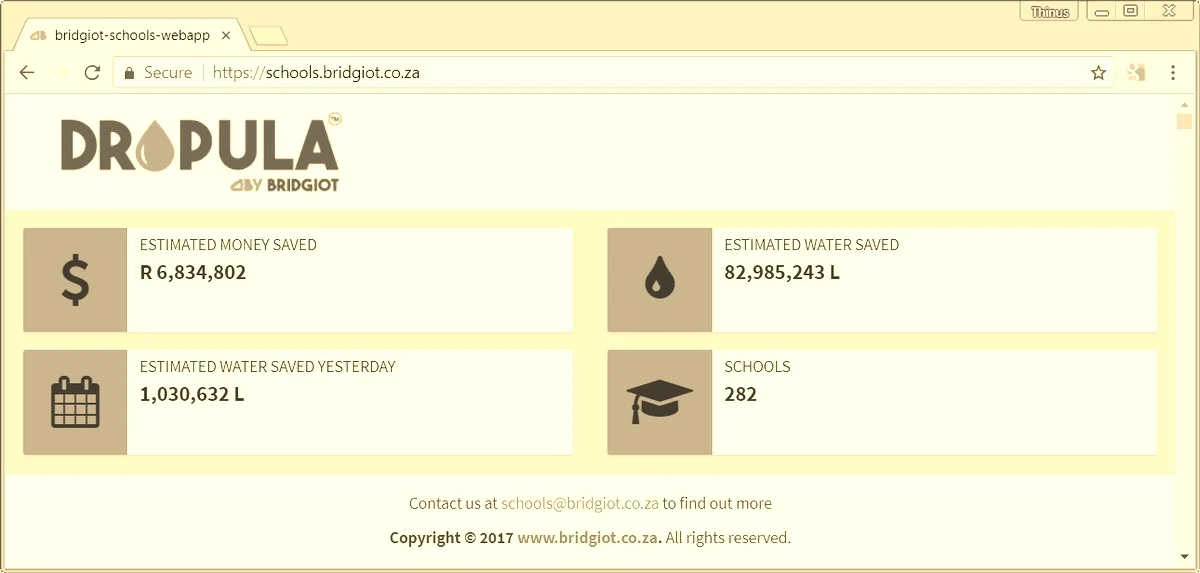
The year also presented us with what can be described as one of the best South African technology solutions - the Geasy and the Dropula. The technology, which was co-created by Thinus Booysen, an Associate Professor at the Stellenbosch University’s Electrical and Electronic Engineering Department, enables unique and granular presentation of data usage.
It generates notifications for exceptions which enables users to take preventative action. It also creates awareness of possible water wasting and empowers users to prevent or reduce the wasting of water as well as allowing online presence for some water meters that are currently operating in an off-line standalone mode.
Reports claim that Hector Peterson Secondary School in Wallacedene has managed to save R52000 a month through the use of the technology. Therein lies an innovation model and lesson. It demonstrates what it takes to create a great technology solution.
The first lesson relates to Booysen the innovator. He has all the credentials of working for Facebook or Google in San Francisco. And besides being an associate professor, he is also a member of the Institution of Engineering Technology, a Chartered Engineer (CEng) at the Engineering Council (UK), and a Professional Engineer (PrEng) with the Engineering Council (SA). He has more than 10 years’ international industry experience in the aerospace and automotive industries with companies that include SunSpace, Rolls-Royce, Boeing, BMW, and Jaguar Land Rover. He has been with Stellenbosch University from 2009 and his research is on the Internet of Things, with a focus on Smart Water and Electricity metering and Intelligent Transport Systems (specifically its application in the informal public transport industry in sub-Saharan Africa). He is also a founder of Bridgiot, and co-creator of Geasy and Count Dropula.
Even though he has so much experience, he has chosen to solve a major societal challenge using his understanding of technology. Lesson here, innovators should focus on developing technology solutions that solve major challenges in society.
Process
The second lesson relates to the importance of university in solving societal challenges. The Stellenbosch University played a critical role in the creation of the water technology. Academic institutions are critical in the innovation process. Every successful innovation hub has an academic institution that is behind its creations.
The third lesson relates to the fact that for technology to be truly useful in society, it has to solve a real challenge. Booysen chose to solve the water challenge at least the information part of the challenge. Knowing how much water is used makes a huge difference as seen in the schools that are using the technology.
The fourth lesson relates to the commercialisation of research from universities. Booysen’s technology could have just died as a research paper in university archives and not been implemented. But he chose to move it from research to commercial product. This is a necessary part of creating an innovation nation.
Research conducted in universities needs to be transformed into economic value. This is how Google was formed at Stanford University by two students who were determined to solve the information challenge.
The last lesson relates to pain that needs to be felt by the innovator in order to create. Booysen could have not created the technology solution if he was not based in South Africa and in the Western Cape in particular where drought is mostly experienced. The lesson is simply that experiencing a challenge and feeling the pain is a necessary part of developing a necessary solution.
This is one of the lessons outlined in the book about Xi Jinping and the Governance of China II. The book highlights the fact that in China, government officials are expected to stay in communities where challenges are experienced and they never leave until the challenge is solved.
This is one of the approaches that may need to be considered by African government leaders and technologist if current challenges are to be solved. Government officials and technologists may need to spend some of their time in areas where challenges are mostly experienced, such as townships.
This approach in 2018 may lead to more solutions and technology products that solve local challenges instead of solutions that are imported elsewhere.
As we move towards 2018 African technology leaders need to think about how technology can be used to solve major challenges in 2018.
Knowing how much water is used is one step in the right direction. However, more is required in terms of solving the availability of water challenge and this will be required more in 2018.
Based on all the reasons outlined here, The Infonomist believes that the water technology developed by Dr Thinus Booysen should be considered the 2017 South African Technology of the Year for creating a technology solution that seeks to solve a major challenge in society through technology.
Post Office was never ready

“The takeover of the grant payment function by the South African Post Office has led to a disaster, at least in the first few days of the new system. On the 3rd November 2017, The Infonomist warned against the decision to move the Grant Payment function to the Post Office: see below”
SA Tech can end SASSA Woes - published on Business Report on the 3rd November 2017
The South African social grant challenge is one crisis that should not be wasted. It is a perfect challenge for technologists to develop a solution that can become a financial backbone for the future.
Social Services Minister Bathabile Dlamini had indicated in Parliament that the department was working towards creating capacity within a government entity. The SA Post Office (Sapo) is one of the institutions that has been considered as a solution provider.
The challenge, however, is that Sapo still has its own challenges. Currently, there is no government entity that can provide a seamless solution.This leaves a hole that cannot be solved even by the private sector, as corruption led to this crisis in the first place. Recall how the current provider used one of its companies to sell services to senior citizens, thereby creating a financial burden for them.
A hybrid solution (financial technology entrepreneurs, financial professionals and government officials and entities) in this regard is necessary to deliver a financial backbone for the future. The solution can be driven by a social enterprise with one goal in mind: to serve the public through a technology system and professionals that care.
This challenge presents an opportunity to create capacity within the state while developing skills and, more importantly, enabling senior citizens to access financial resources without worry and concern. One of the major challenges cited about the social grant issue is that there’s a need for recipients to have bank accounts.
While this is important for financial integrity, it is also important to note that technology has advanced to the point that this challenge can be solved without the need for a bank. Across the world, there’s a trust deficit as people rely less and less on banks.
This is true especially in the African continent. Think of M-Pesa, a cellphone-based money transfer, financing and microfinancing service, launched in 2007 by Vodafone for Safaricom.
The service allows users to deposit money into an account stored on their cellphones, to send balances using PIN-secured SMS text messages to other users, including sellers of goods and services, and to redeem deposits for regular money.
M-Pesa is a branchless banking service. Customers can deposit and withdraw money from a network of agents that include airtime resellers and retail outlets acting as banking agents for a small fee.
Although the conditions that gave rise to M-Pesa were the lack of advanced banking systems in Kenya, that reason alone should serve as an inspiration for a financial technology (FinTech) solution to be considered in the social grants fiasco.
Bankless
If Africans in Kenya could build M-Pesa to enable bankless people to access the financial system, what is stopping African tech thinkers and entrepreneurs in South Africa from coming up with a solution to this challenge?
Currently, South Africa boasts some of the finest FinTech leaders who are respected across the globe. One such entrepreneur is Vinny Lingham, who, according to Wikipedia, founded Civic, a start-up that encrypts identity information on the blockchain in 2015.
Civic raised in excess of $33million (R465.36m) in funding during its Initial Coin Offering in June of 2017. Two months later it partnered with WikiHow, providing the how-to website with encrypted login functionality. Lingham currently serves on the board of the Bitcoin Foundation, an authority in the crypto- currency space.
Another well-respected South African in the FinTech space is one Hannes van Rensburg, who is regarded as the godfather of financial technology in the African continent.
Van Rensburg founded Fundamo, a company that was recognised as one of the biggest mobile payment platforms in emerging markets. At least one in every three mobile payment transactions was running on the Fundamo platform at the time in those countries it was present in.
The company was subsequently acquired by Visa - the leading payment solutions corporation.
These two South Africans could lead a 60-Day FinTech Hackathon to develop world class FinTech solutions for the social grants challenge in collaboration with computer science graduates, financial gurus and government officials with keen interest in serving the people.
Headache
Thereafter, a social enterprise for this purpose can take over. These efforts could bring an end to Dlamini’s current headache (assuming she’s really looking for a great solution).
A solution to this challenge would have to take into account the future. Current solutions are focused on maintaining the status quo by sustaining current providers of financial services and current systems.
The social grants problem is an opportunity for South Africa to build a financial system for the future and to avoid previous mistakes of outsourcing key government services.
In the process of developing a solution, there’s a need to safeguard the key part of this process, that is, data of senior citizens. Depending on the solution that will be considered, there’s a potential to either safeguard or lose out on the critical data of senior citizens.
The beauty of considering the hybrid solution is that the data of senior citizens will remain locally and safeguarded. Such data will be useful in taking care of senior citizens for other needs that are non-financial in nature and avoiding exploitation, as it has been the case with the current service provider.
OPEN DATA Initiative : SA Data Economy Under Construction

Uber, the world’s leading transport technology company, uses geographical data to know how to move people from one place to another, while Tesla, the innovation machine in the vehicle manufacturing space, is also using geographical data to enable automation which allows the car to drive itself.All of these companies would not have been possible without geographical data. The same is true of other technological innovations that will dominate the fourth industrial revolution. Data is the secret sauce for creating companies of the future. It is for this reason that the Data Economy matters for society today, especially for the African continent.
President Cyril Ramaphosa, addressing Parliament in May, alluded to the value of data when he was outlining what needs to be done about land. The president indicated that there’s a need for land data in order to inform decision-making processes around land allocation in South Africa.
The truth of the matter is that data on land exists; however, it is not easily accessible. In fact, since South Africa is a signatory of the “Open Government Declaration”, such information should be easily accessible to everyone.
The declaration calls for South Africa to champion Open Data, which is a phrase that refers to enabling and making available government data and shareable public information.
Open Data also includes making information about health, crime, education, transport, finance and important aspects of society available in its raw format for governance, accountability and, more importantly, economic development.
The accessibility of data is a critical area if South Africa is to create a thriving data economy.
According to the Digital Economy Report by Digital Reality in Europe, the Data Economy is worth trillions.
In Germany, the size of the data economy is £100.8billion (R1.68trillion), and its untapped potential is estimated at £87.9bn. In the UK the size of the data economy is estimated at £73.3bn and its untapped potential is estimated at £53.3bn.
Currently, no one knows the exact value of the South African data economy. However, it can be concluded that billions are wasted based on data that is not used for economic value.
There’s a need to move government data from resting in government databases by making it available for better use.
Currently, there are many stumbling blocks in creating the data economy.
Although efforts to make government information available through avenues such as the data portal and government websites have improved, more can be done in regard to the following matters:
* Lack of quality data sets;
* Lack of open data policy;
* Lack of data leader.
Lack of ideal open data
The publicly available data is not structured in the manner that makes it possible to create digital assets such as Uber, AirBnB and other tech innovations made possible by data. Although there are some companies that were created based on data in South Africa, more can be done to make sure that more of these companies can be created.
Lack of open data policy
Another area that needs attention in order to create the data economy is a data policy that will inform the manner in which the government makes data available to the citizens.
Once such data policy has been established, it will need to be reviewed from time to time to ensure that it aligns to the needs of society.
Lack of data leader
More importantly, for the data economy to thrive, there will be a need for data leadership in the country.
Lack of leadership in this regard makes it difficult for data projects to be implemented seamlessly.
A starting point in this regard may be a ministry that may focus on technology and with a particular focus on creating the data economy.
What will enable data economy?
The time is now for South Africa to take the data economy seriously through the manner in which it makes data available, by developing a data policy and by appointing leaders who will advance the data economy of the country.
Today the IEEE Open Data Initiative is beginning a process of developing an open data standard.
This standard which will serve as an instrument that can provide guidance on how open data can be accessible.
The IEEE Open Data Initiative is currently based in the Western Cape, with various stakeholders across the board participating in the development of an open data standard.
The open data standard development process will be conducted over the period of two years, starting with workshops in 2018.
NIC HARRY: A Model For SA Tech Young Entrepreneurs

Nicolas Haralambous, 34, better known as Nic Harry, is the perfect model of a young entrepreneur in South Africa. His story ought to be a mandatory case study for school learners, university students and young entrepreneurs, especially in the technology sector.
To learn from Nic about technology entrepreneurship, you have to look at his businesses, which cut across industries with tech as a common thread. His first business, Motribe, was in the technology sector, his second in retail and his new venture is in the media space.
Motribe
Nic co-founded Motribe, a mobile community platform that grew to more than a million members and which was acquired by Mxit.
The acquisition process of this company taught Nic a lot about exiting a company. He is one of the few young people in South Africa who has built a company and, thereafter, sold it for millions at a very young age of 27.
His lesson in this regard can serve as a great lesson for young entrepreneurs on how to build and sell a company.
Subsequent to selling his company to Mxit he founded a fashion retail brand now known as NicHarry.com.
He believes that more young entrepreneurs in South Africa should learn from another. This is one of the reasons why he wrote a book about his life experiences as an entrepreneur.
He based it on his daily diary to inspire other entrepreneurs.
Another business from which young entrepreneurs can learn from Nic is his lifestyle and fashion business, NicHarry.com, which is named after himself.
NicHarry.com
The NicHarry.com brand is synonymous with the new approach to retail, which Nic has championed. Nic started it in 2012, with a core product of socks made from bamboo, which are designed and knitted in Cape Town. Currently the company offers a full range of products that include socks, ties, scarves and umbrellas.
In addition, he has just launched underwear as second core product.
Nic noticed that there was a lot of choice for the ladies, whereas the men were left with boring grey, black and brown. This is a gap that he chose to exploit with NicHarry.com.
The fashion retail company founded by Nic has applied tech in its execution through selling his products online and still enable access to the physical store.
Nic’s approach to retail serves as a great lesson for young fashion designers, who wish to create their own brands.
According to Nic, the focus of NicHarry.com is less about retail, but more about the experience you feel when you purchase an item from NicHarry.com stores. Nic believes that in retail the customer's experience matters for survival.
As a typical entrepreneur Nic has not been satisfied by his business activities in tech and retail as he is now working on starting a media company.
The media company is an integration of Nic’s life experiences in media and technology. He studied media at Rhodes university and cut his teeth in journalism at 702 (Talk Radio) and at Financial Mail . His interest in tech and media has culminated in the creation of his new media company, an online publication dedicated to covering the FinTech industry.
Lesson for entrepreneurs
The general lesson in Nic’s entrepreneurial life is summed up by the theme of his new book titled: Do.Fail.Learn.Repeat -The Truth Behind Building Businesses. The book outlines Nic’s life experiences in his entrepreneurial journey of building tech businesses and tech-enabled business. You can order a copy of the book on Nic's personal website: nicharalambous.com
What Universities Can Learn From Tech Startup Hubs
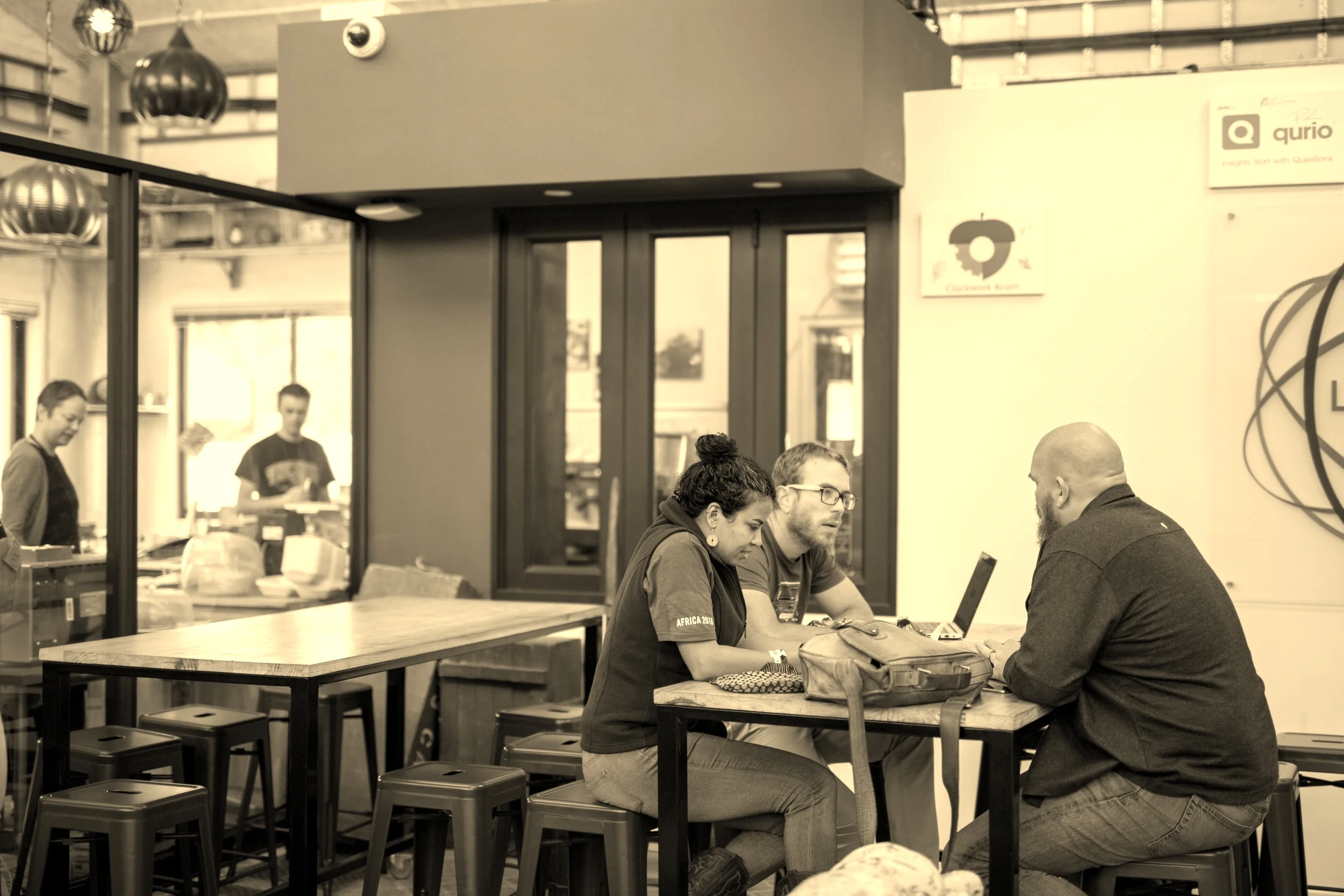
Startup team members in meeting at Launch Lab
As youth Month draws to an end, society will move on to other matters of national importance. Yet, young people in South Africa still have less chance of securing an employment opportunity after spending years at an academic institution.
Many are beginning to ask questions about the relevance of academic institutions if all one gets for studying is much debt and no employment opportunity. This situation should move society to begin a process of overhauling academic institutions to be entrepreneurial entities that develop people who employ others.
This view was recently suggested at a gathering of academic entrepreneurs (a phrase coined by Professor Michael Morris) at UCT. Academics questioned the relevance of a university under current conditions of youth unemployment and recommended that there’s a need for entrepreneurial universities.
The idea of entrepreneurial universities is partly inspired by the rise of start-ups that were founded by students. Think Mark Zuckerberg at Harvard and Sergey Brin and Larry Page, who founded Google at Stanford University. There’s a litany of companies that were formed by students at universities that are now worth trillions.
Some students at universities have demonstrated the ability to come up with innovative solutions. Recently the German Society for Mechatronics recently awarded outstanding work in the field of mechatronics. All over Germany, universities were invited to submit their best bachelor theses. The winning idea came from Aalen: Philip Frenzel, who won first place with his thesis.
His clever idea to develop a kind of “mobile phone airbag” convinced the judges and it is already registered for a patent. Academic institutions are a hotbed of great innovations that need to be harnessed to benefit society and create jobs. In South Africa, some universities have begun a process of unleashing innovations through start-up accelerators for their own students.
Stellenbosch University (LaunchLab), University of Cape Town (Solution Space) as well as Tshimologong by Witwatersrand University are great examples of academic institutions that are environments for the support of entrepreneurship by students.
The LaunchLab at the University of Stellenbosch is a start-up incubator that has the goal of building a thriving ecosystem for entrepreneurs within the university and beyond. LaunchLab provides office space, facilities and incubation programmes along with expert advice, mentorship and access to funding for University of Stellenbosch students and business bcommunity at large.
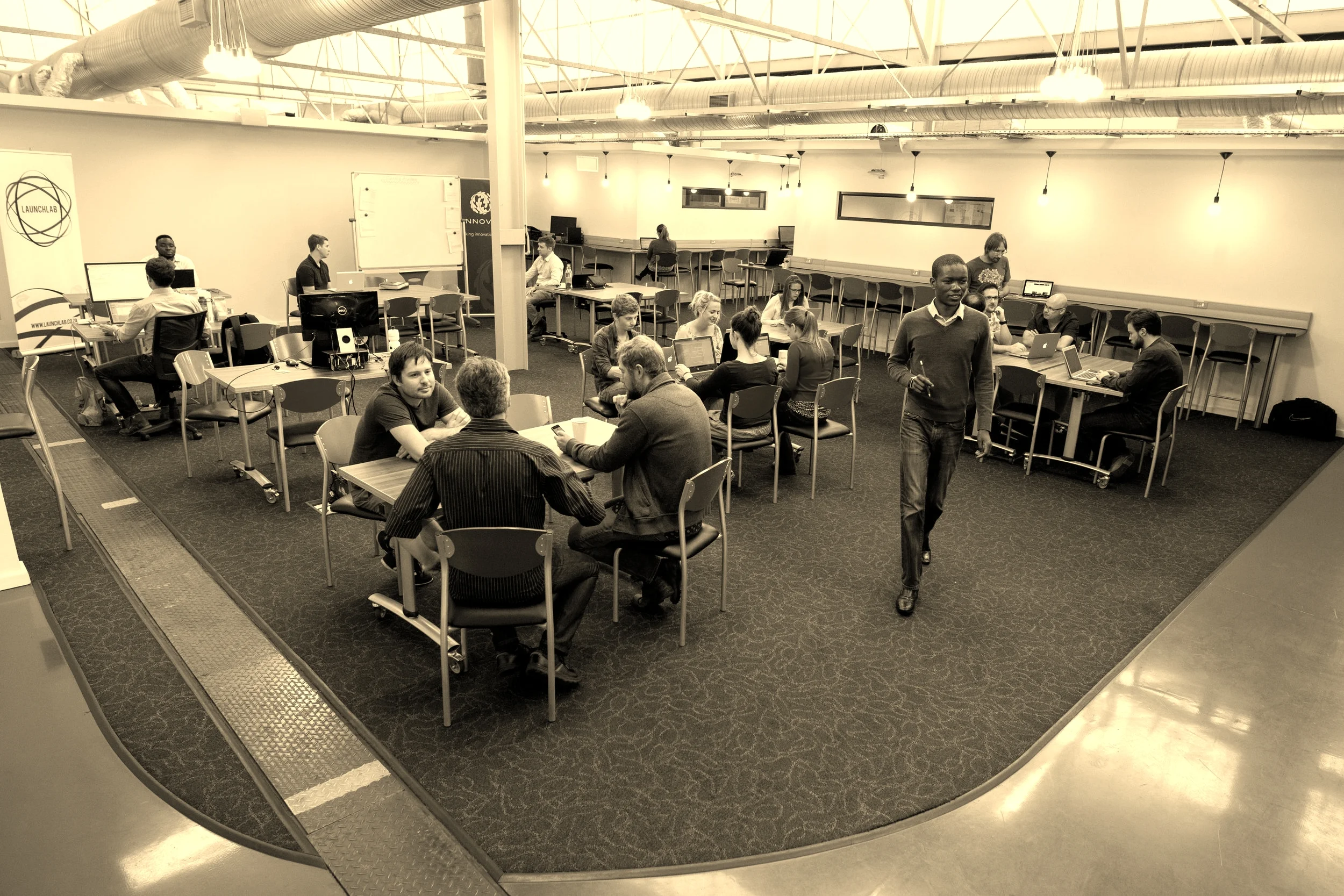
LaunchLab hotdesk area with members working with each other
LAUNCHLAB
LaunchLab is already showing signs of success. One of the start-ups from LaunchLab was a winner at VivaTech, an international technology platform in France. VivaTech is one of the largest technology conferences in the world, attracting more than 66000 people, and over 200 speakers, including the chief executives of Facebook, Microsoft, IBM and Uber, and some of the most respected brands in the world, including LMVH, Verizon and SoftBank.
VIZIBILITI
Vizibiliti Insight, a start-up from LaunchLab, was selected and invited to present at #VivaTech 2018 after being shortlisted from more than 110 applications of more than 30 countries, for Verizon’s alternative credit scoring challenge.
Verizon selected Vizibiliti Insight as the overall winner of Customer Experience Transformation through Digital Challenge.
Vizibiliti Insight’s alternative scoring solution enables any credit provider to provide credit safely for difficult to analyse customers, who otherwise would be refused credit.
Vizibiliti is working on specialised credit scoring solutions for South African entrepreneurs, often considered too high-risk for banks and other credit providers to lend to.
The aim of the solution is to support credit worthiness applications of these businesses and individuals who, although contributing to more than 40percent of South Africa’s GDP, would be declined credit without further consideration.
Another interesting university entrepreneurship entity is Tshimologong at the University of Witwatersrand. Tshimologong is a dynamic development that encourages tech innovation and collaboration between the university’s researchers and students and the private, public and civil society sectors in Johannesburg.
The space has flexible open plan co-working areas with broadband connectivity for ICT start-ups, meeting and refreshment zones, computer laboratories, training rooms, maker spaces, creative content development environments, and administrative and infrastructure support offices.
Start-up accelerators at universities have yielded success for many universities that have adopted this approach to develop entrepreneurial students. Speaking at the Lekgotla on Entrepreneurial Universities at Entrepreneurship Development in Higher Education, Tope Toogun from Cognity Advisory highlighted the need for entrepreneurship to be embedded in South African universities.
He suggested that this can be done by developing academic entrepreneurs (academics who are entrepreneurial) as well as entrepreneurial students. Currently there are a couple of universities in South Africa that do not have start-up accelerators.
This year’s Youth Month should inspire academic institutions to not only reflect about youth development matters in June, but by doing something and by creating real solutions to avoid the unemployment of their graduates.